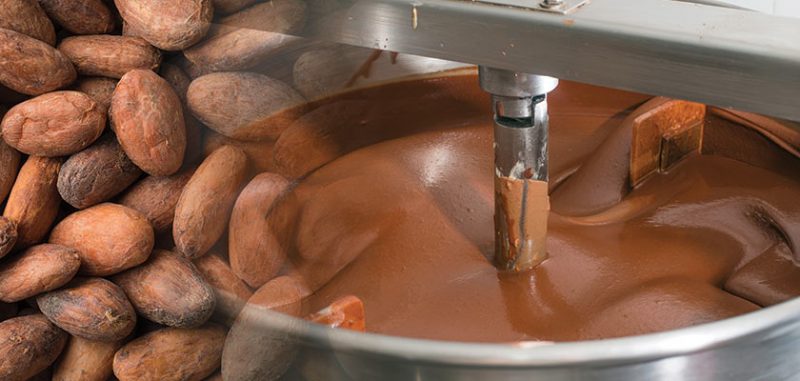
Chef Prish explains the different styles of machines used to grind and conche chocolate at home. She discusses the features, pros and cons of stone melangers, wet grinders, roller mills and more.
As a budding chocolate-maker, you will soon be faced with the hard decision of what machine you will use to grind and conche chocolate you are crafting. While the general principle of conching chocolate remains the same – crushing chocolate until it becomes a mass of microscopic-sized particles – the tools you can use to achieve this goal vary.
In this article, Chef Prish discusses the feature, pros and cons of the various equipment and machines used to grind and conche chocolate, to help you decide which option is the best match for your chocolate-making aspirations, kitchen and budget.
What Machines Do You Need to Grind & Conche Chocolate?
Before we get started talking about the best machine to grind and conche chocolate, it is essential to understand why chocolate conching takes place, and what the goal is. Ultimately, the purpose of conching chocolate is to break down the particle size, to give it the smooth and pleasant mouthfeel we know and love.
In her previous article how to make chocolate with cocoa beans (bean to bar), Chef Prish discussed the chocolate conching and grinding process, grinding science and cocoa particle size in depth. Below is a quick summary:
- Cocoa particles are measured in micrometers (aka microns, or μm):
- The lower the μm, the more refined the chocolate is.
- The higher the μm, the coarser the chocolate is.
When grinding and conching chocolate, our goal is to strike a balance between refined and coarse. Chocolate that is too refined isn’t good, but neither is too coarse.
In chocolate-making, the big question is then, what particle size is the best to aim for? There is no hard rule, since the ideal cocoa particle size (μm) varies by country, however it tends to range from 10 μm to 30 μm. With this in mind, you will want to choose a machine capable of grinding/conching chocolate at the particle size you desire. See below:
What Machine Should You Use to Grind & Conche Chocolate?
Research shows that ball mills produce the most consistent liquor, are the easiest and most affordable to maintain, and last the longest. However, they are also expensive, and therefore not suitable for most home cooks and hobbyists. For beginners, a Wet Grinder is going to be your best option to grind and conche chocolate at home, since they are small and inexpensive. Ultimately, you want to use what you are most comfortable with and what is most reasonable for your needs.
| Product | Description | Link |
|---|---|---|
| Premier Lifestyle Tilting Wet Grinder – 2 Liters | A versatile tilting wet grinder perfect for chocolate making and Indian cooking. Features natural granite roller stones that grind at low speed and temperature to preserve nutrients and flavor. The tilting feature allows easy emptying of the drum once finished. Includes complimentary Coconut Scraper and Atta Kneader attachments. UL and CSA certified for electrical safety in USA and Canada. The 200-watt motor is designed for years of reliable use while reducing energy consumption. | Check Price |
| Premier Small Wonder Table Top Wet Grinder – 1.5 Liter | This compact table-top wet grinder is perfect for small families and home chocolate making. Features natural granite stones that grind at slow speed and low temperature to preserve nutrients and flavor. The unique toplock design ensures fine consistency grinding. Energy-efficient processing reduces grinding time by up to 50% with no loss to nutritional value. Includes complimentary Coconut Scraper and Atta Kneader attachments. Lightweight, easy to disassemble and clean. All components are food safe and BPA free. Ideal for making chocolate, idli/dosa batter, chutneys, and masa from scratch. | Check Price |
| Butterfly Peerless 3-Stone Wet Grinder – 2 Liter | The Butterfly Peerless is a premium 3-stone table-top wet grinder perfect for chocolate melanger applications and traditional Indian cooking. Features three cylindrical grinding stones for uniform and faster grinding compared to single-stone grinders. The stainless steel drum is durable and easy to clean. Includes complimentary Atta Kneader and Coconut Scraper attachments. Shock-proof ABS body provides safety and durability. Designed for 110V operation in USA and Canada with manufacturer support. | Check Price |
What Are Some More Professional Options?
For those of you who plan to make this a long term hobby, you might want to consider these middle to high range options.
| Machine | Application | Pros | Cons |
|---|---|---|---|
| Stone Melanger | Home; Commercial | 15-25 μm particle size Capable of both grinding and conching* | Expensive |
| Wet Grinder (aka Indian Spice Grinder) | Home | 15-25 μm particle size Affordable Capable of both grinding and conching* | Less durable |
| Ball Mill | Commercial | 15-25 μm particle size | Incapable of conching (grinding only)* Expensive |
| Roller Mill | Commercial | Up to 25 μm particle size | Incapable of conching (grinding only)* Expensive |
| Stone Metate | Home | Long lasting Reliable, consistent Affordable | Labor intensive |
Stone Melanger
To grind cocoa, you can use stone grinders or melangers, which are stainless steel drums with two rotating granite wheels positioned in the middle of the drum on a stone slab. They spin to crush and refine the particles over 24 – 72 hours. You can expect liquor ranging from 15 – 25 μm depending on how old the machine is, and the duration of grinding.
When purchasing a melanger, make sure the motor runs on copper wiring instead of low-grade aluminum. Also, check the quality of the granite wheels. Good quality granite should be uniform in color and texture. It should be hard and dense and emit a clear, ringing sound when struck. Cocoatown is a universally popular brand. You can find a selection of equipment for home-to-professional use on their site.
COST: Stone melangers are expensive but still accessible for serious home chocolate-makers. For the entry level melangers from Cocoatown, expect to pay $600-1,200.
Wet Grinder / Indian Spice Grinder
Wet grinders or Indian spice grinders are used to grind spices, grains, pulses, and nuts into powders, batters, or milk. They work exactly like stone melangers and some chocolate makers swear on them for grinding to conching, but others say they don’t have the durability to grind and conch for several days at a time. They are an excellent way to test out chocolate-making as a hobby, without investing too much money.
COST: Wet grinders are affordable and easy to find from Indian supermarkets and even Walmart. Expect to pay $300-500.
Ball Mills
Ball mills refine liquor to between 15 – 25 μm. They are steel cylinders with water jackets around them. They contain 80,000 tiny steel or ceramic balls ( 9 – 10mm each) inside, which when heated up, grind and refine the cocoa to liquor. The ground cocoa is sucked through a pump at the bottom of the drum and fed back into the drum at the top, to be refined over and over again.
A shaft with protruding arms along the middle of the drum constantly agitates the cocoa around the tiny steel balls. When the water gets too hot, it is automatically drained and new water is filtered in. Ball mills also have a vent for acetic acid to be sucked out. Ball mills can be small enough to use at home and large enough for industrial use. Read more about the different kinds of ball mills here.
COST: Ball mills are usually expensive, large scale machines used for commercial chocolate production. Smaller styles suitable for home use may exist, but are difficult to find.
Roller Mills
Roller mills work in a similar way to stone melangers, except the rolls are placed flush against each other, from the largest gap at the top, to smallest at the bottom. They are made of steel or ceramic stone and are designed to refine cocoa to 25 μm. With additional rolls, the fineness can be further enhanced. Heat temperatures are controlled through a water cooling system and the cocoa particles can only move between the rollers if they reach a specific size at each roller. Read more about roller mills here.
COST: Roller mills are usually expensive, large scale machines used for commercial chocolate production. Smaller styles suitable for home use may exist, but are difficult to find.

Stone Metate
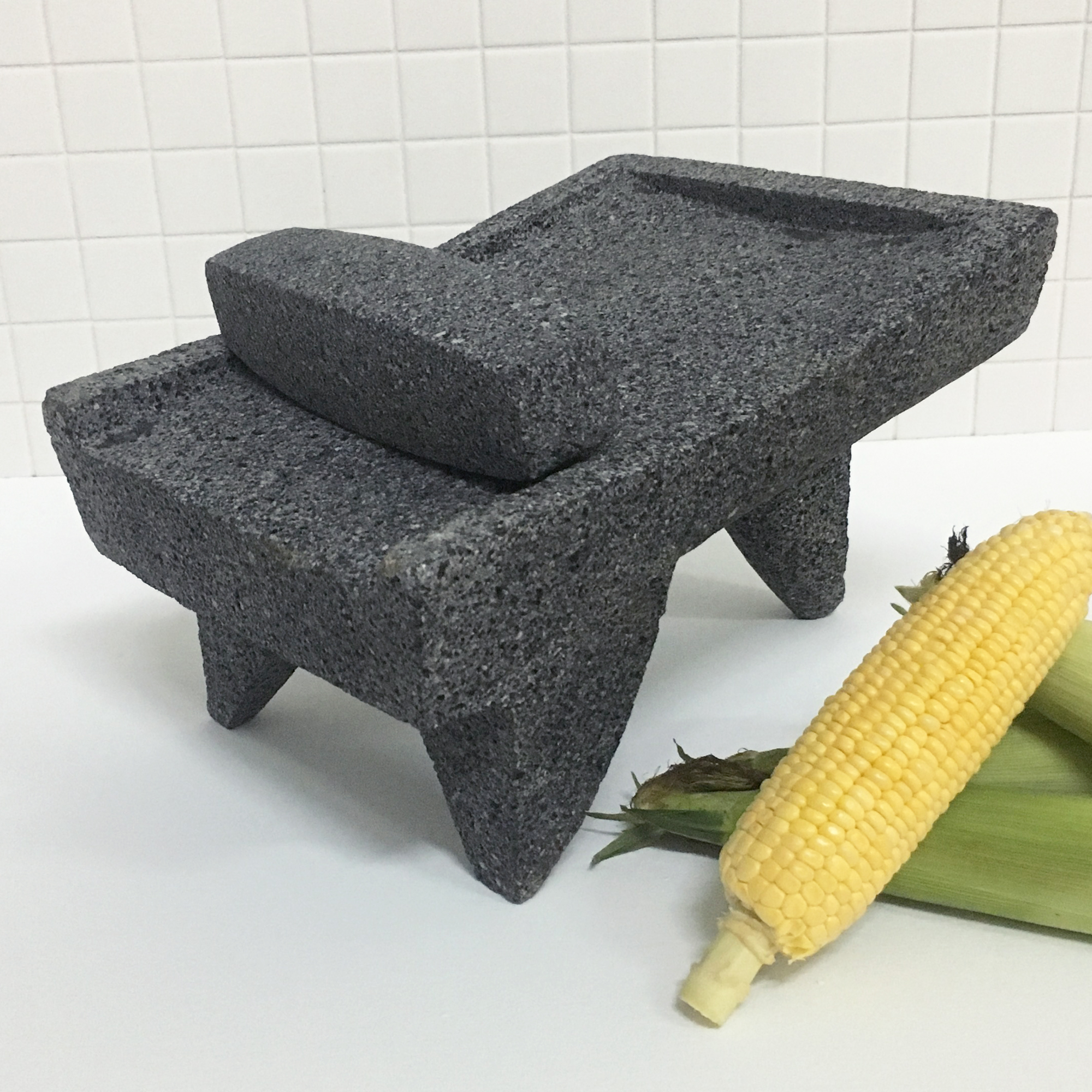
The stone metate is the OG of grinders, dating back to the early archaic period, (8,500 BP – 5,500 BP). The metate is a warmed stone slab on which grains and seeds are crushed to powder or paste with a heavy stone pestle. Although labor-intensive, they are still used today to create cocoa liquor by some artisanal makers. A quality stone metate is comparable in price to a Wet Grinder, so if you want to save yourself the arm-aching work of crushing cocoa by hand, you may want to get a wet grinder instead.
COST: Stone metates are reasonably priced and can be found online at Amazon, eBay, Etsy and specialty stores. Expect to pay $200-500.
Final Thoughts
We hope this piece from Chef Prish has given you a good overview of the best machines to grind and conche chocolate at home.
After this, you may still be wondering:
- Do I REALLY need a special machine to grind and conche chocolate?
- Can’t I just use what I already have at home?
If this is you, then you might like to consider this quote from Chef Prish in her earlier article How to make chocolate from cocoa beans: “Unfortunately, a blender or processor does not conch chocolate. The lowest micron reported is 90 μm…”
By way of comparison, chocolate needs a particle size smaller than 35 μm, so a food processor is not going to ‘cut it’ for chocolate-making.
Therefore, it leaves little option other than to purchase a dedicated chocolate grinder and chocolate conche, or a wet grinder. To cut your costs, try to find a machine that is capable of both grinding and conching chocolate, such as a stone melanger or wet grinder. This way, you don’t have to purchase and maneuver two different machines.
If you aren’t ready to invest in one of these machines and you don’t mind a coarse chocolate, lastly, you could try to grind and conche the chocolate by hand using a mortar and pestle. It is certainly possible, just don’t expect a smooth chocolate like you would get from the store… and be prepared for a heavy arm workout!
For more chocolate equipment buying tips, check out Simon Knott’s article on Chocolate-Making Tools & Equipment You Should Invest In.
Happy Chocolatiering!
Fo